
Industrial Dryer Factory Acceptance Test
Quick Answer
An industrial dryer factory acceptance test, or FAT, is a contract-defined pre-shipment review of specified equipment, documents, workmanship and functional behavior that can be demonstrated before delivery. It is not a universal checklist and it does not replace site commissioning or a validated material drying trial. The buyer and supplier should agree the test boundary, procedures, witnesses, acceptance criteria, records and treatment of open items for the actual configuration.
Confirm agreed functions before shipment.
A FAT can reduce ambiguity by comparing the assembled supply against approved project documents before it leaves the factory. The useful boundary is the equipment and functions actually available for inspection. A drying room built at site, final utilities, field ducts, site drainage or a production batch may not be present at the factory. Those items need separate site checks.
Commissioning guidance from the U.S. Department of Energy emphasizes planned tests, documented results, deficiency tracking and handover records. ASHRAE commissioning resources similarly describe verification against project requirements. These principles support a disciplined FAT, but neither source defines a universal HPDRYER FAT scope. The contract and approved configuration remain controlling.
Agree the basis before anyone witnesses a test.
Approved Documents
Equipment list, drawings, electrical information, control description and revision status.
Test Boundary
Equipment present, temporary connections, simulated signals and unavailable site functions.
Acceptance Criteria
Expected observations, permissible deviations and objective pass/open-item definitions.
Records and Witnesses
Responsible parties, sign-off method, photographs, data sheets and action ownership.
Separate inspection, energization and functional demonstration.
| Stage | Typical contract-defined checks | Record |
|---|---|---|
| 1. Document review | Configuration, equipment list, revision status, labels and agreed test procedure. | Document register and approved procedure. |
| 2. Visual inspection | Accessible workmanship, component identity, guards, cabinet condition and obvious shipping items. | Inspection checklist and photographs. |
| 3. Electrical readiness | Terminations, protective devices, grounding provisions and supply compatibility, checked by qualified personnel. | Signed electrical readiness record. |
| 4. Control functions | PLC modes, sensor input simulation, commands, alarms, interlocks and controlled stop where included. | Expected versus observed response. |
| 5. Unloaded operation | Fan direction, abnormal noise, indicated temperatures, actuator response and accessible moisture path. | Operating observations and open items. |
| 6. Closure | Deficiency disposition, retest needs, exclusions and shipment release responsibility. | FAT report and action register. |
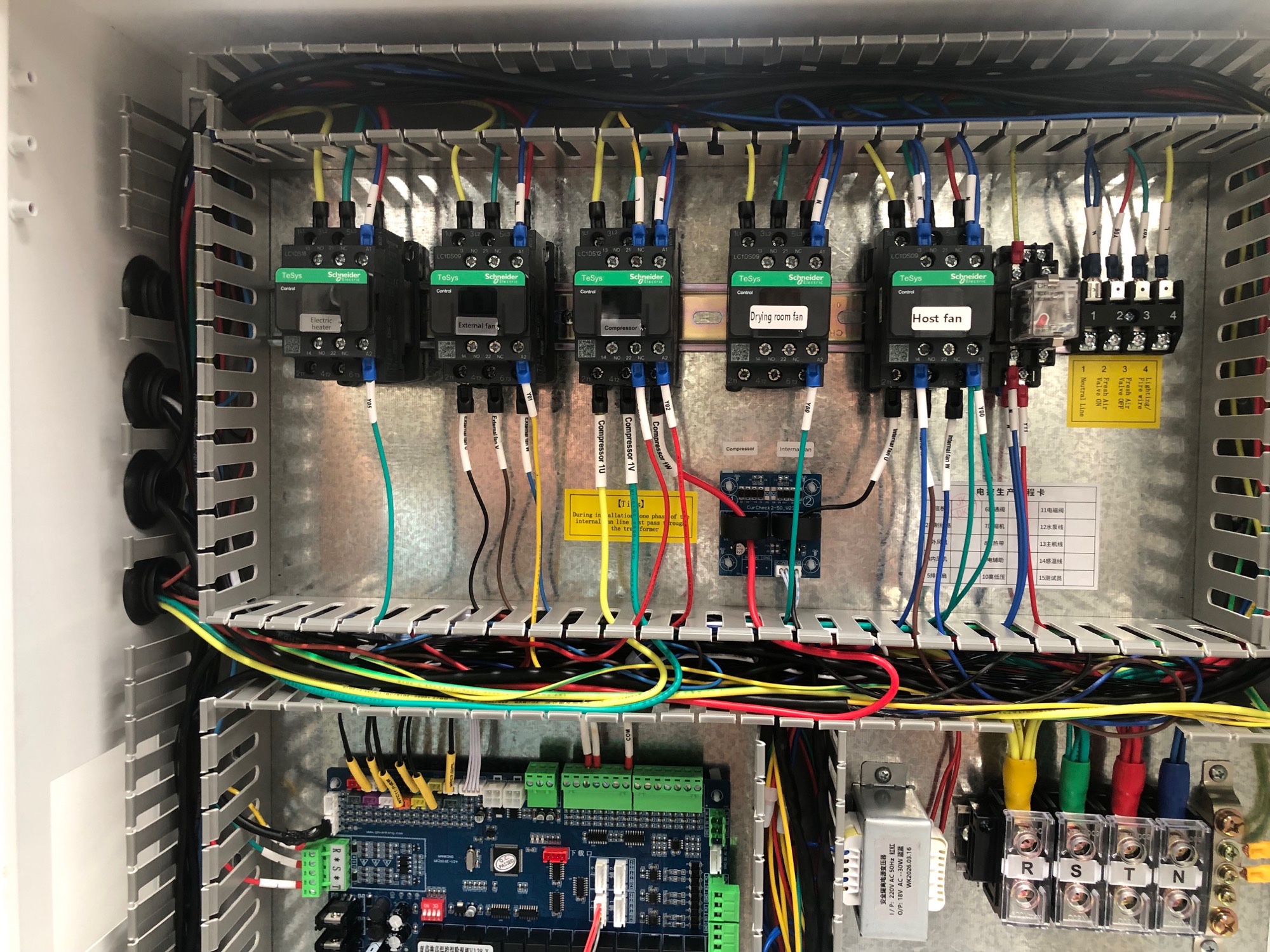
Inspect the supplied configuration, not a generic photograph.
The authentic control-cabinet image shows visible electrical components and wiring associated with an industrial drying system. It can support discussion of cabinet condition, component identification, documentation and control checks. It does not prove compliance with any electrical standard or demonstrate a completed project FAT.
Where fan assemblies are part of the supply, direction and command response may be checked using a safe agreed procedure. Airflow performance at site can still differ because the room, ducts, filters and loaded material resistance are not necessarily reproduced during FAT.
Do not confuse pre-shipment checks with installed performance.
| Question | Factory acceptance test | Site commissioning |
|---|---|---|
| Location | Before shipment, at the agreed factory test location. | After installation at the project site. |
| Boundary | Supplied equipment and functions available for demonstration. | Installed system, site utilities, room, drainage and interfaces. |
| Airflow | Direction and accessible unloaded functions. | Actual room, duct and loading-path verification. |
| Material | Usually excluded unless a specific test is contracted and feasible. | Defined loaded trial under recorded conditions. |
| Outcome | Shipment release, open-item register or agreed retest. | Installed-function records, trial results and handover. |
See the Industrial Dryer Commissioning Checklist and Installation Requirements for the site-stage boundary.
Items that must be confirmed rather than assumed
- Which equipment, options and documents are included in the witness scope?
- Which test signals are real and which are simulated?
- What temporary power, loads, ducts or instruments are available?
- What acceptance criteria and tolerances apply to each step?
- Who may witness remotely or in person, and who signs release?
- How are deficiencies, retests, shipment release and unresolved items handled?
Factory acceptance questions
Is FAT included in every HPDRYER project?
It should not be assumed. Scope, witnesses, records and commercial responsibility must be confirmed in the contract.
Does FAT prove drying performance?
Not unless an agreed representative material test is included and its conditions are documented. Empty operation is not a production guarantee.
Can FAT replace site commissioning?
No. Site utilities, room boundaries, installation and loaded airflow require site verification.
What happens when a result is open?
Record the expected and observed result, responsible party, corrective action, retest basis and release decision.
Connect FAT with records and handover.
Define the FAT boundary with the project scope.
Share the equipment configuration, required records, witness expectations and site-stage responsibilities before the test plan is agreed.