
Heat Pump Dryer Energy Consumption
Quick Answer
Heat pump dryer energy consumption must be measured as electrical energy over a defined batch or reporting period. Add the compressor, process-air fans, auxiliary heaters, controls and any other loads inside the agreed boundary. Power in kW describes an instantaneous rate; energy in kWh describes accumulated use. A useful project comparison also records the water removed, material condition, cycle time, climate and loading arrangement.
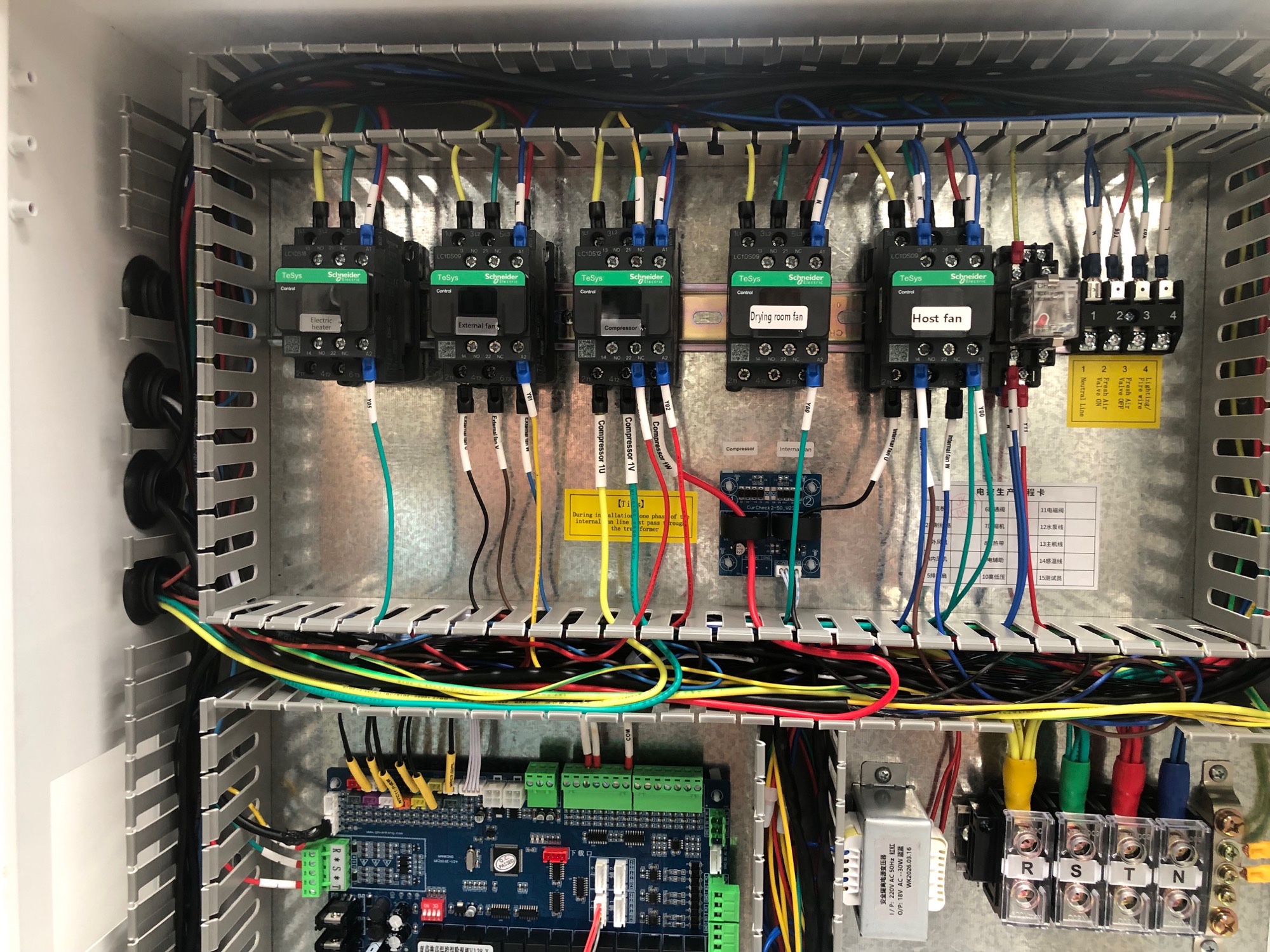
Define what the energy figure includes.
An energy number is meaningful only when the measurement boundary is stated. A machine-only meter may exclude room fans, auxiliary heat or external ventilation, while a site feeder may include unrelated loads. Record the meter location, start and stop conditions, batch interruptions and whether loading, preheating, cooldown and cleaning are included.
Compressor
Record the electrical input of all compressor stages over the complete measured period, including cycling and part-load operation.
Fans and Air Movement
Include supply, return, exhaust and condenser or evaporator fans that belong to the drying process boundary.
Auxiliary Heating
Measure electrical resistance heaters or other auxiliary loads separately when possible, including their actual operating time.
Controls and Other Loads
Include PLCs, pumps, dampers, actuators, defrost functions and project-specific auxiliaries when they draw energy inside the boundary.
kW and kWh answer different questions.
| Quantity | Engineering meaning |
|---|---|
| Power (kW) | The rate of electrical energy use at a moment or averaged over a short interval. It is relevant to electrical supply and demand. |
| Energy (kWh) | Power accumulated over time. For a constant load, energy equals power multiplied by operating hours. |
| Batch energy (kWh/batch) | Total metered energy between the agreed batch start and stop points. |
| Specific energy (kWh/kg water) | Batch energy divided by the measured or mass-balance estimate of water removed. |
The National Institute of Standards and Technology identifies the watt as a unit of power and the kilowatt-hour as electrical energy; 1 kWh equals 3.6 MJ. See the NIST SI conversion reference.
Calculate each load over its actual operating time.
Batch energy = sum of each load’s average power x its operating time
Specific energy consumption = batch energy / water removed
Use kW and hours to obtain kWh. When a load varies, use interval meter data or a measured average rather than nameplate power alone. Determine water removed from representative mass and moisture measurements using a consistent moisture basis. The moisture removal calculation explains the wet-basis mass balance.
Hypothetical calculation example
Assume, only for illustration, that a compressor averages 12 kW for 8 hours, fans average 3 kW for 8 hours, controls average 0.2 kW for 8 hours, and an auxiliary heater operates at 4 kW for 2 hours. The illustrative batch energy is 96 + 24 + 1.6 + 8 = 129.6 kWh. If verified mass data shows 90 kg of water removed, the illustrative specific energy is 129.6 / 90 = 1.44 kWh per kg of water. This is not an HPDRYER rating or guarantee.
Energy changes with material, climate and workflow.
- Material and moisture: initial moisture, target moisture, product dimensions and internal moisture movement affect the duty and time.
- Loading: tray depth, rack spacing, bypass paths and batch uniformity affect fan work and drying progress.
- Climate: open-loop intake temperature and humidity can change available drying potential; closed-loop systems remain affected by leakage and room losses.
- Controls: setpoints, staging, defrost, auxiliary heat and endpoint logic change when loads operate.
- Room and maintenance: insulation, door openings, filters, coil cleanliness and airflow resistance influence system operation.
Energy should therefore be reviewed together with dryer sizing, airflow design and the actual operating schedule.
Use metering and material records from the same period.
Define the Boundary
List every electrical load and the exact batch start and stop conditions.
Measure Energy
Use a suitable meter and retain interval data when loads cycle or modulate.
Measure Moisture
Record fresh and final masses with representative initial and target moisture data.
Record Conditions
Document material form, loading, climate, setpoints, interruptions and endpoint method.
Energy consumption questions
Can nameplate kW predict batch electricity?
No. Nameplate power does not show actual load, cycling or operating time. Use measured energy over a defined batch.
Should fan energy be included?
Yes when the fans are necessary to the measured drying process. State the boundary so comparisons include equivalent loads.
Is the lowest kWh always the best result?
No. Endpoint moisture, uniformity, product requirements, throughput and complete process time must also be satisfied.
How is electricity cost estimated?
Multiply measured kWh by the applicable tariff, while separately considering demand charges, time-of-use rates and other billing rules.
Continue the measurement and sizing review.
Build an energy review around the real drying duty.
Share the material, moisture data, batch load, operating schedule, climate, loading arrangement and available electrical information for project-specific review.