
Industrial Moisture Removal Calculation
Moisture removal review connects fresh material quantity, initial moisture, target moisture and process assumptions. Final sizing requires project-specific data.
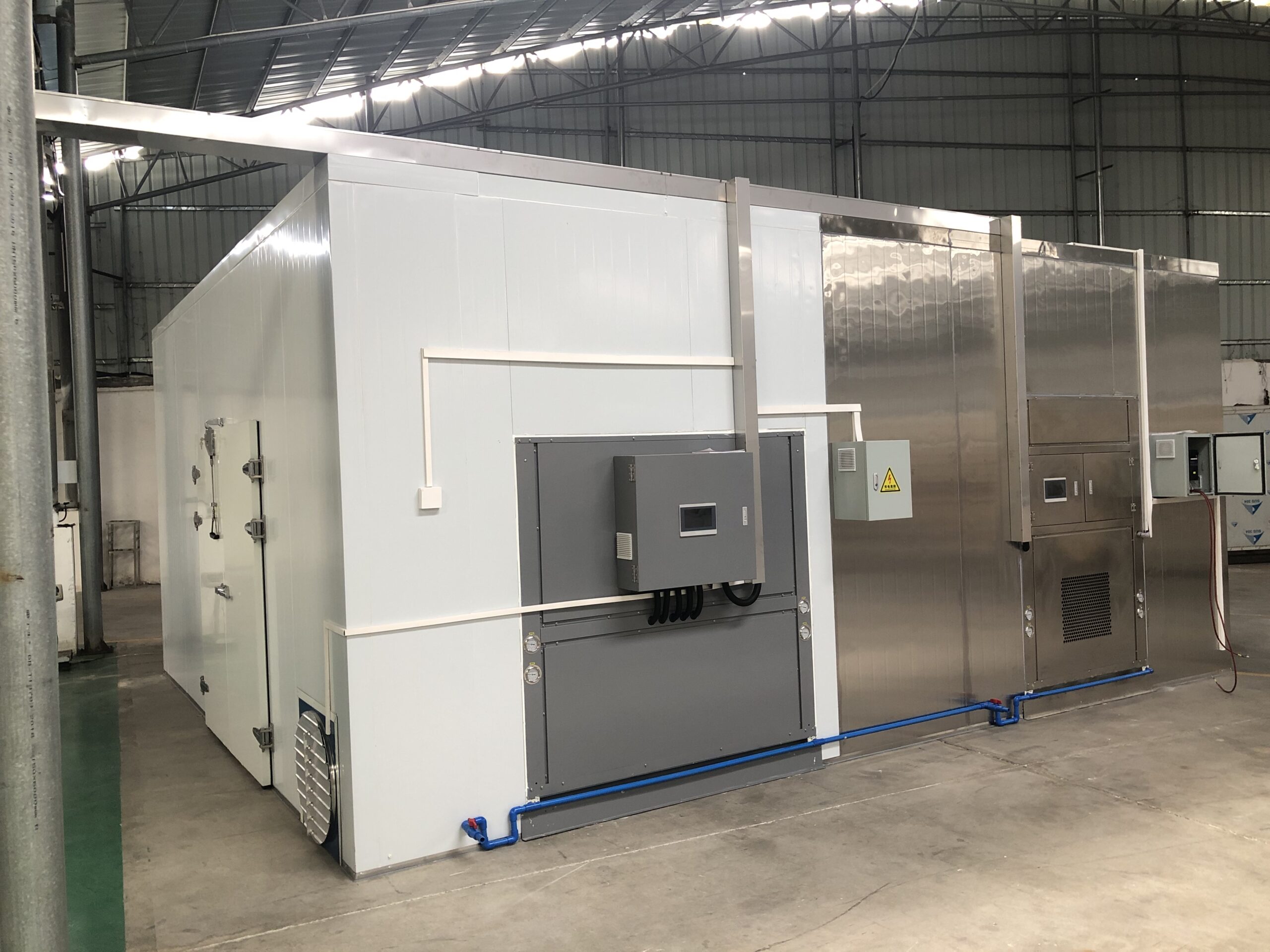
Moisture load affects the system review.
A useful estimate starts with material quantity and moisture basis, then considers target moisture, process time, losses, climate and the practical moisture discharge path.
Information used for the first engineering review.
Fresh quantity
Mass entering the process and whether it is per batch or per day.
Initial moisture
Moisture basis and test method if available.
Target moisture
Required endpoint or dried condition if known.
Process assumptions
Batch schedule, preparation and expected operating workflow.
Define variables before calculating.
A basic mass-balance discussion may use fresh mass, dry-solids mass, initial moisture fraction and target moisture fraction. The basis and units must be explicit; final sizing requires engineering review.
Illustrative wet-basis mass balance
Assume Mf = 1,000 kg fresh material, Xi = 0.60 initial wet-basis moisture fraction and Xt = 0.10 target wet-basis moisture fraction.
Dry-solids mass: Md = Mf x (1 – Xi) = 1,000 x (1 – 0.60) = 400 kg.
Final product mass: Mp = Md / (1 – Xt) = 400 / (1 – 0.10) = 444.44 kg.
Estimated water removed: Mw = Mf – Mp = 1,000 – 444.44 = 555.56 kg.
Xi and Xt are decimal fractions using the same wet-basis definition. This is an illustrative mass-balance example, not an equipment guarantee. Real sizing also considers process time, losses, climate and validated material data.
| Review item | Engineering question |
|---|---|
| Basis | Are percentages wet basis or dry basis? |
| Mass | Is the stated quantity fresh material or dry solids? |
| Endpoint | Is target moisture measured or only an approximate goal? |
| Time | What batch or operating schedule should the estimate represent? |
Translate material moisture data into a mass-balance basis before discussing moisture-removal capacity.
- Moisture basis: Keep wet-basis and dry-basis values clearly separated.
- Capacity: Relate moisture load to batch size and operating schedule.
- Discharge: Consider condensate, exhaust and room moisture paths.
- Validation: Use measured material data when available.
Questions that should be resolved early.
- Mixed units: Do not combine fresh mass, dry mass and percentages without a stated basis.
- Fixed promises: A calculation is not a performance guarantee.
- Missing process time: Moisture load alone does not define equipment selection.
Carry the moisture basis into capacity and system planning.
Have a project to review?
Share material, moisture, capacity, climate, loading, airflow and control information with HPDRYER.