
Industrial Drying Cycle Time Factors
Industrial drying cycle time is an outcome of moisture duty, material preparation, loading, air conditions, available moisture-removal capacity and the operating schedule. It is not a universal number that can be selected from the equipment name alone. A useful planning review separates process time from loading, unloading, warm-up, checks and any hold or conditioning stage, then validates assumptions with representative material tests.
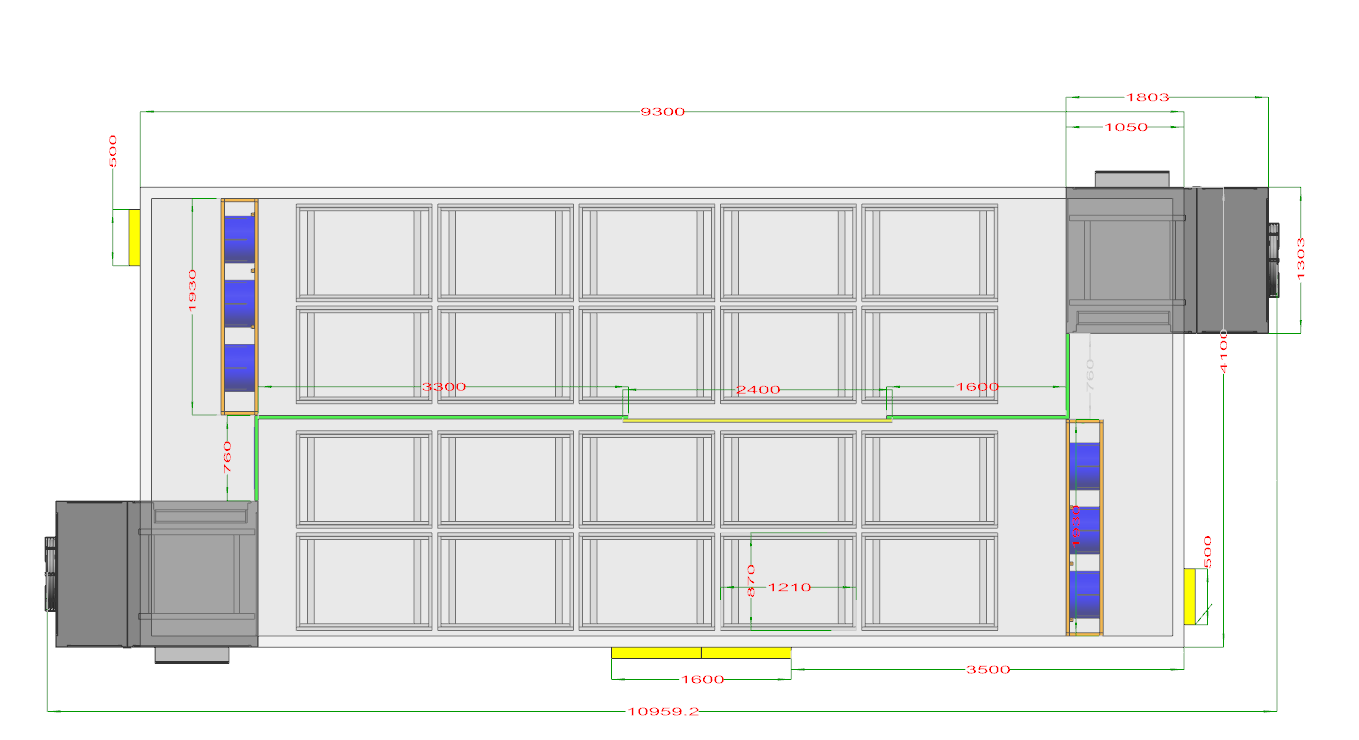
Cycle time must be defined by the actual process
Start with fresh mass, initial and target moisture on a stated basis, product dimensions, layer and loading density, air temperature and humidity observations, airflow arrangement and the required endpoint. Then separate active drying from loading, unloading and validation time. A cycle estimate is an engineering hypothesis until material tests or verified process data show how the load responds under defined conditions. Do not treat an illustrative calculation as a capacity or drying-time guarantee.
What changes the time required
Moisture basis
Initial and target moisture must use a clearly stated wet-basis or dry-basis definition. The moisture duty changes when the basis or endpoint changes.
Product geometry
Thickness, cut size, surface condition and arrangement affect the path for moisture to leave the material.
Loading resistance
Layer condition, tray loading, trolley spacing and bulk density influence air distribution and the exposed process surface.
Air conditions
Temperature, humidity, airflow and room leakage change the driving force and the uniformity of the process.
Schedule overhead
Loading, unloading, inspection, cleaning and conditioning affect daily throughput even when active drying time is unchanged.
Separate batch duration from daily throughput
A simple planning relationship is:
daily fresh-material throughput = batch fresh-material capacity × completed batches per day
Completed batches per day depend on active process time plus loading, unloading and other scheduled time. The relationship is useful for planning, but it does not determine equipment capacity or prove a production schedule. Use the capacity calculation page and moisture-removal calculation with project data.
| Input | Why it matters | What to document |
|---|---|---|
| Fresh mass and moisture | Defines the approximate moisture duty | Mass, moisture basis, initial and target values |
| Material geometry | Changes internal and surface moisture paths | Dimensions, cut method, surface condition |
| Loading arrangement | Changes airflow resistance and exposure | Tray, layer, trolley and room layout |
| Air condition | Changes moisture-removal potential and uniformity | Temperature, humidity, airflow observations |
| Schedule | Converts cycle time into daily planning | Loading, unloading, checks and operating hours |
Use examples to show the method, not a promise
Illustrative only, not an HPDRYER performance guarantee: assume a planning basis of 100 kg fresh material per batch and a hypothetical active drying duration of 8 hours, followed by 1 hour for loading and unloading. If one complete batch occupies 9 scheduled hours, the simple schedule would be approximately 24 ÷ 9 = 2.67 batch opportunities per day before considering shifts, cleaning, inspections or downtime. This does not prove that 8 hours is achievable. The active duration must come from representative material testing or verified process data, and the actual moisture duty and endpoint must be confirmed.
Measure the cycle in stages
- Record fresh mass, preparation, loading and initial moisture basis.
- Log temperature and humidity at defined locations through the process.
- Record intermediate mass or moisture observations using a consistent method.
- Document endpoint criteria and quality observations separately from time.
- Repeat comparable trials before converting the result into a planning range.
Use the trial and process validation page for a structured record. Final sizing also needs room, airflow, controls, climate and operating schedule review.
Questions buyers and operators ask
Can a supplier guarantee a cycle time from material name alone?
No. Material condition, moisture, geometry, loading and endpoint requirements must be defined and tested.
Is final moisture the only endpoint?
No. Quality observations, uniformity, handling condition and customer acceptance criteria may also matter.
Does a larger batch always take proportionally longer?
Not necessarily. Loading resistance, air distribution and equipment duty may change with the batch arrangement.
Should loading time be included?
Yes, when planning daily throughput. It is separate from active moisture-removal time.
What should be included in an RFQ?
Provide material form, fresh mass, moisture basis, target endpoint, preparation, loading method, schedule and available room information.
Continue the planning review
Plan a cycle-time review
Share material, moisture, loading and schedule information at sales@hpdryer.com.
Do not hide uncertainty inside a single number
A buyer may ask for one cycle time, but the engineering record should preserve the assumptions behind it. Note whether the material is at a typical or difficult moisture condition, whether the load was evenly distributed, whether the room was empty or loaded, and whether the endpoint was based on measured moisture or a quality observation. Also note available operating hours and whether the schedule includes cleaning, inspection and changeover.
Where material variation is significant, a planning range with stated conditions is more useful than a precise unsupported promise. Revisit the range when material size, loading density, climate, room layout or target quality changes. Supplier discussions should distinguish observed test evidence, design assumptions and items still requiring confirmation.